
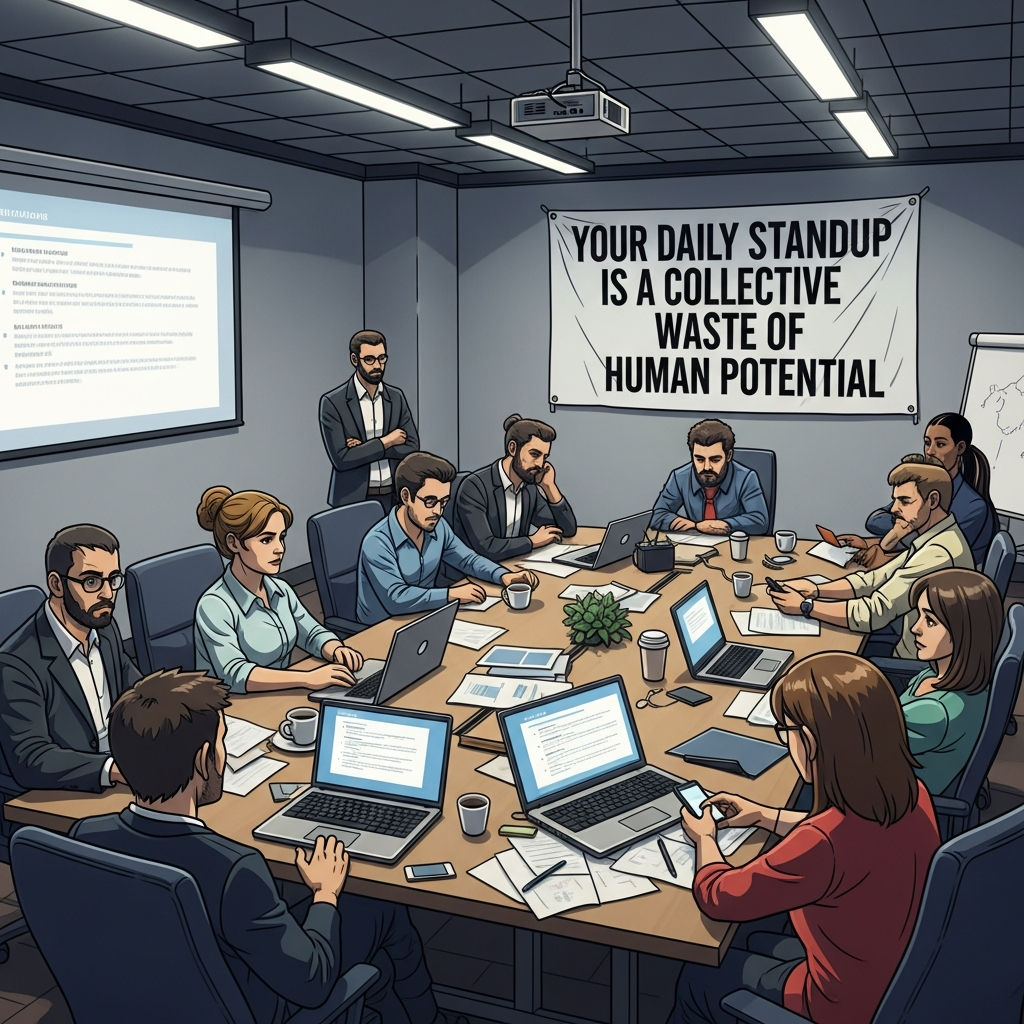
The Silent Killer of Engineering Productivity: Why Your Daily Standup is a Collective Waste of Human Potential
Every morning, at thousands of companies across the globe, a ritual takes place. High-value engineers, creative designers, and strategic product managers stop what they are doing, gather in a circle (or a Zoom grid), and spend fifteen to thirty minutes reciting a script. This script—the classic “What I did yesterday, what I’m doing today, and any blockers”—is the hallmark of the Agile Daily Standup. But beneath the surface of this well-intentioned ceremony lies a grim reality: the traditional standup has become a primary drain on cognitive energy and a monumental waste of human potential.
What was designed to be a quick alignment tool has devolved into a performative status report that prioritizes micromanagement over momentum. If your team treats the standup as a mandatory roll call rather than a strategic huddle, you aren’t just losing time; you are destroying the flow state of your most talented people.
The Ritual of Performative Productivity
The original intent of the Daily Standup, as defined in the Scrum Guide, was to inspect progress toward the Sprint Goal and adapt the Sprint Backlog. It was never meant to be a status update for a manager. However, in most corporate environments, the standup has morphed into a theater of “busyness.”
When engineers feel they must justify their existence every 24 hours, they begin to optimize for visibility rather than impact. This leads to several destructive behaviors:
- Task Padding: Breaking down simple tasks into complex-sounding updates to avoid looking “idle.”
- The Status Script: Reciting a list of Jira tickets that everyone can already see on the board, leading to a collective “tuning out” by the rest of the team.
- Anxiety-Driven Development: Feeling pressured to have a “finished” update every morning, which can lead to rushed code and technical debt.
When the standup becomes a performance, the “human potential” of the team is diverted from solving complex problems to managing perceptions.
The Astronomical Cost of Context Switching
From an SEO and management perspective, we often talk about “efficiency,” but we rarely talk about the “cost of re-entry.” Software development, writing, and design require deep work—a state of intense concentration where the most significant breakthroughs happen. It takes an average of 23 minutes to return to a state of deep focus after a single interruption.
If your standup is at 10:00 AM, the hour leading up to it is often wasted because the developer knows they will be interrupted soon. The 15-minute meeting itself, followed by the 23-minute recovery period, effectively kills a two-hour block of high-value cognitive time. When you multiply this by a team of eight people, a single “quick standup” can cost the organization 16 hours of collective brainpower every single day. Over a year, that is thousands of hours of potential innovation traded for a meeting that could have been an email.
The Math of the Standup Drain
Consider the following breakdown of a typical “15-minute” standup for a team of 10:
- Direct Meeting Time: 150 minutes (15 mins x 10 people).
- Pre-meeting “Waiting” Time: 100 minutes (10 mins of low productivity before the start).
- Post-meeting Recovery: 230 minutes (The time taken to regain flow state).
- Total Daily Loss: 480 minutes (8 full hours of human potential).
In this scenario, you are losing one entire person-day of work every single morning. Is the information gained in that meeting worth the salary of one full-time senior engineer? Rarely.
Why “The Three Questions” are Obsolete
The traditional “Three Questions” (Yesterday, Today, Blockers) were created in an era before real-time collaborative tools like Jira, Linear, Slack, and Notion. In a modern tech stack, the answers to “What did I do?” and “What am I doing?” are already visible to anyone who looks at the kanban board.
Reciting these facts out loud is a redundant exercise. It treats highly skilled professionals like children in a classroom. When information is pushed synchronously (everyone listening to one person) rather than pulled asynchronously (checking a dashboard when needed), it creates a bottleneck. If a developer is blocked at 2:00 PM on Tuesday, waiting until 10:00 AM on Wednesday to announce it is a failure of the system, not a success of the ritual.

The Management Ego Trap
So, why does the daily standup persist despite its obvious flaws? Often, it is because of the “Management Ego Trap.” For managers, the standup is the highlight of the day. It provides a sense of control and a tangible feeling that “work is happening.” It is a moment where they are the center of attention, receiving reports from their subordinates.
However, leadership should not be about monitoring; it should be about clearing the path. A manager who insists on a synchronous daily standup for status updates is often admitting they don’t know how to use their own project management tools or that they don’t trust their team to work without supervision. This lack of trust is the ultimate killer of human potential.
The Alternative: Reclaiming Flow and Autonomy
If the traditional standup is a waste, how do we ensure alignment without the cognitive tax? The answer lies in moving from synchronous reporting to asynchronous alignment.
1. The Asynchronous Standup
Utilize tools like Slack or specialized apps (e.g., Geekbot, Standuply) to have team members post their updates whenever they start their day. This allows individuals to provide updates without breaking their flow. Team members can read these updates at their convenience, and managers can get their status fix without a meeting invite.
2. The “Blocker-Only” Huddle
Instead of everyone speaking, hold a meeting only when there is a significant blocker that requires a real-time brainstorm. If the board shows that everything is moving, cancel the meeting. Empower the team to say, “We are all clear today,” and give them back their time.
3. “Walking the Board”
If you must meet, don’t focus on the people; focus on the work. Start from the “Done” column and move backward. Ask: “What do we need to do to get this specific ticket across the finish line?” This shifts the focus from individual accountability to collective problem-solving.
4. The Office Hours Model
Replace the mandatory standup with optional “Office Hours” where the Lead or Manager is available for 30 minutes. If someone has a hurdle, they drop in. If not, they keep coding. This respects the autonomy of the developer and ensures that time is only spent when there is a genuine need for communication.
The Psychological Benefit of Trust
Beyond the time saved, removing the daily standup sends a powerful message to your team: “I trust you to do your job.” When you stop demanding a daily account of every hour, you foster an environment of ownership. People begin to work toward goals rather than toward 10:00 AM updates. This shift in mindset is where true innovation happens. Human potential is unlocked when people feel they have the agency to manage their own time and the space to dive deep into complex problems without the looming shadow of a calendar interruption.
Conclusion: The Path Forward
The Daily Standup is a relic of an early-Agile world that hasn’t kept pace with the realities of modern remote work and the high cognitive demands of the technology industry. It has become a safety blanket for management and a burden for contributors. To truly maximize human potential, we must be willing to kill the “sacred cows” of Agile.
Start by auditing your standup. Is it actually helping you ship code faster? Is it resolving blockers in real-time? Or is it just a 15-minute interruption that costs your team hours of deep work? If it’s the latter, it’s time to stop standing up and start letting your team work. The most productive thing you can do for your team tomorrow morning is to cancel the meeting.