Audient’s iD2 interface adds hidden mic cost for room correction
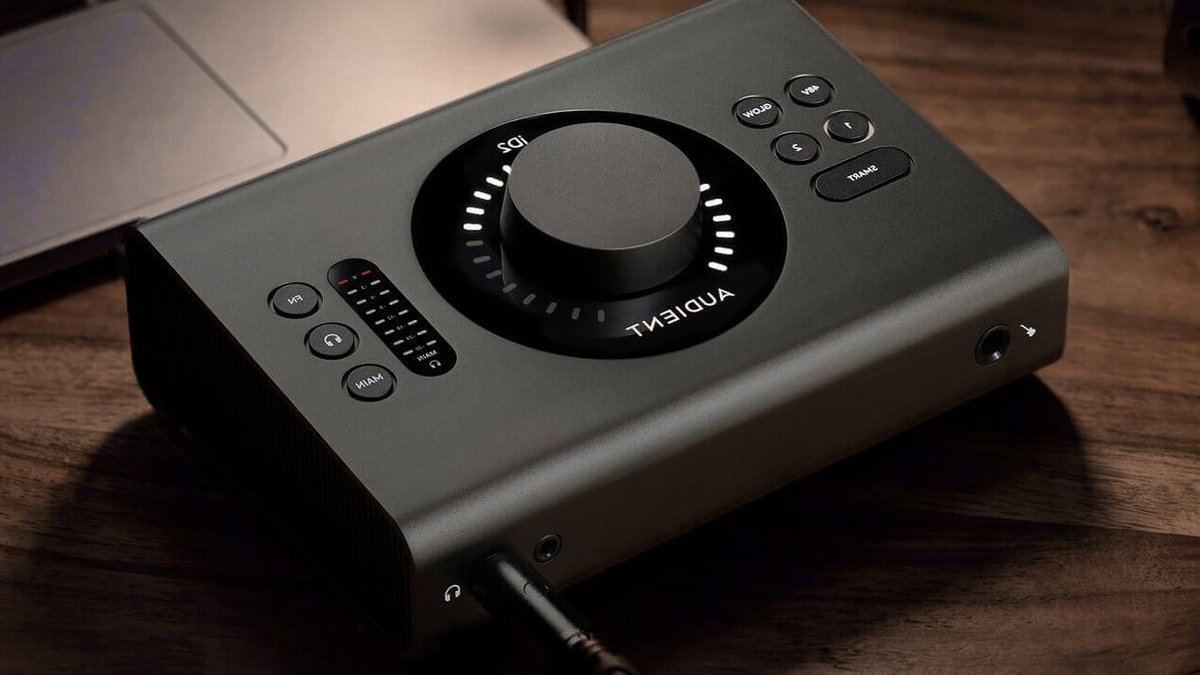
Audient’s new iD2 audio interface launches at a US list price of $299, but its key RoomTune room-correction feature requires the RM1 reference microphone, priced at $54.99. This adds $55 to the cost, bringing the total to $354. The company revealed its four-model iD MK3 lineup on November 12, with the iD2, iD2+, and iD4+ now available through authorized dealers. The entry-level iD1 will arrive in early 2027.
The pricing structure reflects each model’s included features. The iD2+ ($499) and iD4+ ($699) bundle the RM1, while the base iD2 requires buyers to purchase it separately. In the US, the iD2 with RM1 ($353.99) costs $145 less than the iD2+, though the higher-end model adds two balanced hardware inserts and expands outputs from six to 14. In the UK, the price gap narrows: the iD2 with RM1 (£269, ~$357) sits £60 (~$80) below the iD2+ (£329, ~$437).
RoomTune runs on the interface’s digital signal processor (DSP), so the correction applies system-wide with no CPU load to everything the computer plays through the speaker outputs, from a DAW to Spotify, with no plugin. The calibration process takes under 20 minutes using the factory-calibrated RM1, and Audient states the adjustments apply to all stereo speaker outputs. Currently, corrections are limited to stereo setups, with headphone support and additional profile options planned as a free future update.
How Audient’s RoomTune Outperforms Rivals
Room correction is not new, but Audient’s approach differs. Its own ORIA Mini ($299) bundles a measurement microphone and stores up to four calibration profiles, yet it functions as a standalone unit requiring an existing interface. The iD2 with RM1 costs about $55 more than the ORIA Mini alone, while including the interface itself.
The iD MK3 models also introduce ORBIT, a relay-based variable-impedance control that adjusts preamp input load across 220, 1,200, and 2,800 ohms. Audient’s documentation uses a Shure SM57—with a nominal 310-ohm impedance—as its reference, noting that moving-coil and ribbon microphones show the greatest tonal change, while solid-state condenser microphones are often largely unaffected. Against that 310-ohm source, 2,800 ohms is roughly a nine-to-one load, close to the 10:1 bridging guideline engineers use, while 220 ohms loads the microphone below its own impedance.
Read Also: Binance warns iPhone users of unpatched crypto hack
Conflicting Specs Plague iD MK3 Launch
Specs for profile counts and ADAT outputs vary across Audient’s launch materials. The iD1 claims 32 RoomTune profiles, while the iD4+ lists two profiles in one section and 32 in its FAQ. ADAT output figures also conflict: the iD2+ page lists 8 channels in one place and 16 in another, with full 16-channel expansion only available at 44.1 or 48kHz. Preamp gain figures differ as well—press reports mention a 75dB increase from prior models, but Audient’s own pages cite 68dB as the baseline, suggesting a 7dB to 17dB boost depending on the comparison.
The iD MK3 range spans $199 to $699, with each model designed for different workflows. The iD1 ($199) replaces the iD4, while the iD2 ($299) succeeds the iD14, both now featuring onboard DSP and RoomTune. The iD2+ and iD4+ add inserts, extra outputs, and bundled microphones. All models support up to 192kHz conversion, though DSP effects, including EQ and compression, are limited to 96kHz. ADAT expansion decreases at higher sample rates: 8 channels at 48kHz, 4 at 96kHz, and 2 at 192kHz.
Power, Latency, and ADAT Limits
The iD MK3 models are bus-powered over USB-C, and the iD2, iD2+, and iD4+ add an ALT POWER port for computers whose USB port cannot supply enough power. Latency figures for the iD MK3 remain unspecified, though Audient’s Horizon Thunderbolt line, lacking onboard DSP, lists 0.99 milliseconds of round-trip latency at 192kHz.
DSP effects, including the iD Control EQ and compression, operate only up to 96kHz, with Audient labeling them as “zero-latency” without providing a numerical value. The iD2+ and iD4+ expand this further, with the iD4+ supporting 16 channels in and out; but only at 44.1kHz or 48kHz.
Audient’s ORBIT impedance-switching feature is not new to the brand. Its Horizon Thunderbolt line, on sale since Sept. 28 with no onboard DSP, includes an ORBIT control on the Horizon 8P. The iD2+ page labels its three settings as PUNCH (2,800 ohms), SMOOTH (1,200 ohms), and VINTAGE (220 ohms), while Audient’s documentation uses a Shure SM57, with a nominal 310-ohm impedance, as its reference. The highest setting (2,800 ohms) approaches the 10:1 load ratio often recommended for moving-coil and ribbon microphones.

Binance warns iPhone users of unpatched crypto hack


