Oldest Quasar Pair Challenges Cosmic Formation Theories
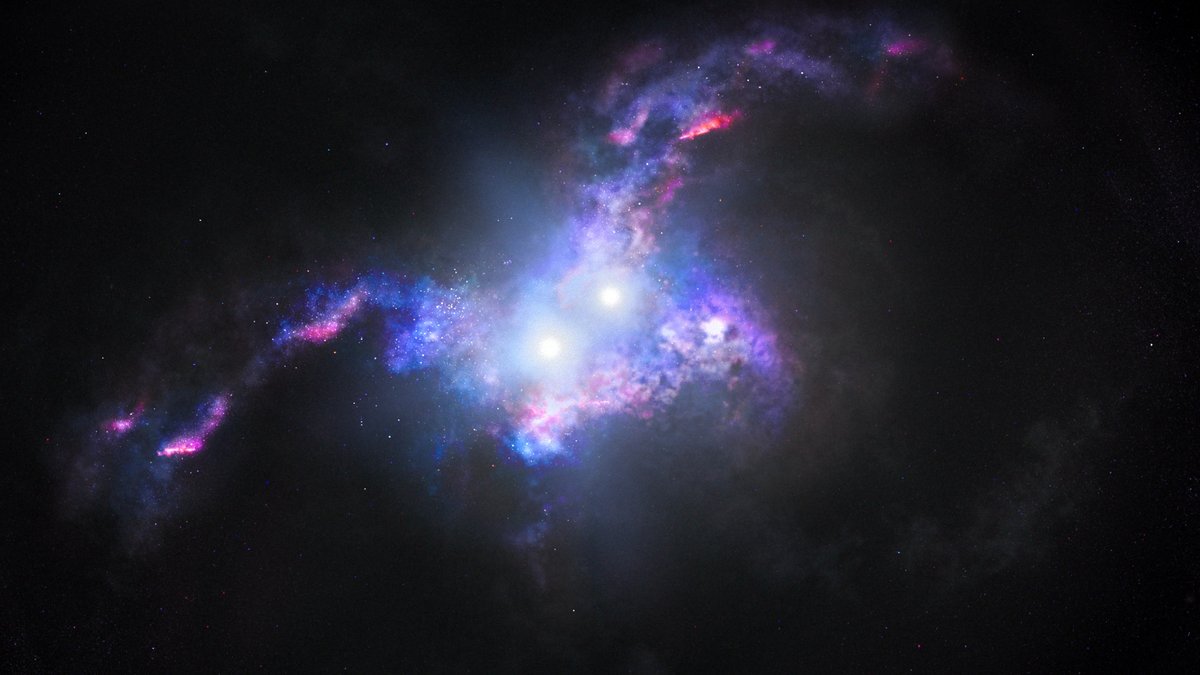
Two supermassive black holes are drifting toward each other in the direction of the constellation Boötes, separated by only about 18,000 light-years. This pair, formally designated J1602+4228AB and known by the Hawaiian name Nāpōʻiwawāʻenakaulua, meaning “the binary void of the heavens,” exists just 900 million years after the Big Bang. The discovery marks the third confirmed compact quasar pair from the Cosmic Dawn era, and it poses a direct challenge to standard cosmological theory. At this early point in cosmic history, neither black hole should be anywhere near this massive.
Two Black Holes That Broke the Rules
The system sits at a redshift of approximately 6.08, meaning its light originated 12.9 billion years ago. Each object is an active quasar, a galaxy nucleus where gas falls into a supermassive black hole so rapidly that it outshines every star in the host galaxy combined. The more massive black hole weighs approximately 1.5 billion solar masses, while its companion is around 400 million solar masses. Together, they represent nearly 2 billion solar masses of black hole material existing when the universe was less than a billion years old.
Standard models of cosmic structure formation predict that black holes grow over billions of years, gradually feeding on gas and merging with other black holes. At this redshift, there simply has not been enough time for gravity and accretion to build objects of this mass. Both black holes are accreting at or above the Eddington limit, the theoretical upper bound on how rapidly matter can fall into a black hole, suggesting they grew faster than standard models of black hole feeding allow.
Read Also: New AI model fools monitor one in four times
Lead author Silvia Onorato, a postdoctoral research associate at NSF NOIRLab, said in the discovery announcement that the finding poses a direct challenge to current formation theory. “There is no definitive theoretical explanation for how these two black holes reached their current masses so early in the universe,” said Onorato, who led the discovery study published in the Astrophysical Journal Letters. “This discovery will force theorists to revisit their models.”
The Black Hole Seeding Problem
The challenge posed by this system is part of a larger problem in Cosmic Dawn astronomy, which has been troubled since the James Webb Space Telescope began observing the early universe. The Epoch of Reionization, which occurred between 150 million and 1 billion years after the Big Bang, has been found to contain more massive black holes than predicted by standard models.
The core issue is known as the black hole seeding problem, where initial objects need to be massive enough to grow into supermassive black holes through accretion and mergers. Standard seeds from collapsing massive stars would need to accrete at or near the Eddington limit for most of the universe’s age to reach the observed masses, which is highly implausible.
Proposed solutions involve direct collapse black holes — massive clouds of primordial gas that bypassed the stellar stage and collapsed directly into black holes of 10,000 to 100,000 solar masses — or runaway mergers in dense star clusters. Neither model fully accounts for the abundance or mass of the supermassive black holes found at Cosmic Dawn redshifts. The existence of this system, with two such objects paired together, compounds the theoretical problem rather than resolving it.
Read Also: Viasat secures $450M contract for Space Force’s missile defense network
The fact that these objects exist so close together in time and space implies that whatever process created them operates differently than current theories suggest. Because the universe is transparent to light in this wavelength range, astronomers can see far back into this era, revealing a universe far more populated with massive black holes than previously believed. This accumulation of counterexamples is becoming difficult for theorists to dismiss.
How It Was Found: A Three-Telescope Chain
The discovery required three separate telescopes operating across different wavelengths and modes, each performing a step that the others could not. The search began with the Subaru Hyper Suprime-Cam (HSC), a wide-field optical-to-near-infrared imager at Subaru Telescope on Maunakea. Using the Lyman-break dropout technique, the HSC survey flagged J1602+4228AB as a candidate at z≈6.08. At this redshift, the Lyman-alpha emission line is redshifted to approximately 861 nanometers, placing it in the near-infrared and causing the object to effectively vanish from shorter-wavelength filter images.
The James Webb Space Telescope then took over. JWST’s NIRSpec Integral Field Unit observed the candidate and provided the first spectra of the two individual sources, confirming their redshifts at z≈6.0781 and z≈6.0785. The NIRSpec IFU observations also detected the MgII and Hβ broad emission lines used to estimate the black hole masses via the virial mass estimator. This observation is part of the Aether Survey, a JWST Cycle 3 program led by Emanuele Paolo Farina of NSF NOIRLab, targeting 343 high-redshift quasars between redshifts 5.7 and 7.0. The angular separation of the two quasars is only about 0.98 arcseconds, close enough that the two objects were initially catalogued as one.
Read Also: Sarepta Ends Trial for Duchenne Treatment
The Gemini North telescope, also located on Maunakea on Hawai‘i Island, provided the confirmatory GNIRS spectra that resolved the two quasars as physically distinct objects at essentially the same redshift, confirming that they form a physically bound system rather than a line-of-sight coincidence.
The Third Discovery of Its Kind: Why the Timing Matters
Nāpōʻiwawāʻenakaulua is the third compact quasar pair confirmed at Cosmic Dawn redshifts, and by some measures the most extreme. The first confirmed Cosmic Dawn compact quasar pair was announced in June 2024 by Yoshiki Matsuoka and colleagues, also using JWST and ground-based telescopes. That discovery established that pairs of quasars could coexist at z~6, but at smaller masses than those found in the new system. In July 2026, the European Space Agency’s Euclid quasar survey announced the discovery of additional high-redshift quasar systems, including the most distant single quasar yet confirmed. The Euclid results extended the inventory of known Cosmic Dawn quasars, providing context for the environments in which compact quasar pairs might form.
A third thread arrived in August 2026, when a system designated LID-1166 was identified as a dual active galactic nucleus at high redshift, confirming that paired or close black hole activity in the early universe is not an isolated phenomenon. Each new discovery narrows the range of theoretical models capable of explaining what JWST is finding at Cosmic Dawn redshifts.


